

CPVC Fire Fighting & Fire Sprinklers - Blazemaster
Firefighter Safety Revolutionized: The Crucial Role of Fire Sprinkler Systems
When discussing advantages of implementing residential sprinkler ordinances across the United States, the primary focus is on enhancing civilian life safety, followed by reducing property damage. However, an equally important aspect seldom highlighted is the positive impact these systems have on improving firefighter safety.
The fire service is considered a paramilitary organization because it operates in a similar way to the military. This means it has a structured chain of command, where everyone has a specific role and follows orders from their superiors. Fire fighters wear uniforms, use ranks like officers and chiefs, and work as a team to respond quickly and efficiently to emergencies, just like soldiers do in the military.
However, there are significant differences between fire service paramilitary and a warfighting military organization. One major difference between the two organizations is found in the use of the term “acceptable casualties.”
“Acceptable casualties” is a term used to describe the number of injuries or deaths that are considered tolerable or permissible in a particular situation, often in the context of military warfighting operations. It reflects a judgment that the potential benefits or objectives of the operation outweigh the expected harm to people involved. This concept is controversial and sensitive, as it involves evaluating human life and safety in the context of achieving specific goals.
In fire service operations, including emergency response and other high-risk rescue activities, the concept of acceptable casualties does not apply; every effort is made to ensure that no injuries or deaths occur. The goal is zero firefighter fatalities via effective risk management.
The consensus standard published by the National Fire Protection Association (NFPA) 1500, Standard on Fire Department Occupational Safety, Health, and Wellness Program, 2021 Ed. states:
- 8.4.4 Risk management principles shall be routinely employed by supervisory personnel at all levels of the incident management system to define the limits of acceptable and unacceptable positions and functions for all members at the incident scene.
- 8.4.2.1* The concept of risk management shall be utilized on the basis of the following principles:
- Activities that present a significant risk to the safety of members shall be limited to situations where there is a potential to save endangered lives.
- Activities that are routinely employed to protect property shall be recognized as inherent risks to the safety of members, and actions shall be taken to reduce or avoid these risks.
- No risk to the safety of members shall be acceptable when there is no possibility to save lives or property.
- In situations where the risk to fire department members is excessive, activities shall be limited to defensive operations.
So, what are major risks to firefighter health and safety today?
According to the International Association of Fire Fighters (IAFF), fire fighter occupational cancer is the leading cause of line-of-duty death in the fire service.
While many factors contribute to this problem, here are just a few on top of the list:
Exposure to Carcinogens: Fire fighters are frequently exposed to toxic substances and carcinogens such as benzene, formaldehyde, asbestos, and polycyclic aromatic hydrocarbons (PAHs) present in smoke and soot.
Inhalation of Smoke: Even with protective gear and breathing apparatus, fire fighters can still inhale harmful smoke and toxic fumes during firefighting operations, even when working in fireground “cold” zones, which can damage their respiratory system.
Absorption Through Skin: Carcinogenic particles can be absorbed through the skin, especially when firefighters are sweating. Firefighting gear and equipment can become contaminated with hazardous substances, which can be transferred to the skin or inhaled when handling the gear.
One highly effective remedy to limit fire fighter exposure to toxic products of combustion at accidental structure fires is a working fire sprinkler system.
According to NFPA, …sprinklers have proven to be reliable in reported structure fires considered large enough to activate them. From 2017 to 2021, sprinklers operated in 92 percent of such fires and were effective at controlling the fire in 97 percent of the incidents…
In simple terms, fire sprinkler systems can significantly minimize firefighters’ exposure to toxic combustion products, thereby reducing injuries and fatalities by controlling or extinguishing fires at an early stage.
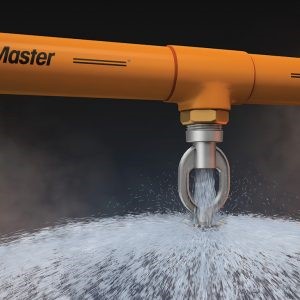
More Than 40 Years of Proven Success
For more than 40 years, BlazeMaster® pipe and fittings have saved lives and property. It has specifically protected the lives of fire fighters by making it safer for them to enter units during responses. The number of lives saved, and injuries or property damage prevented, far outweigh any perceived negatives. For example, fire fighters can be concerned about the flammability of CPVC itself.
In point of fact, BlazeMaster CPVC is extremely resistant to ignition. It has a flash ignition temperature of 900°F (482°C). That is the lowest temperature at which sufficient combustible gases evolve and can be ignited by small internal flame. Wood ignites at 500°F (260°C) or lower. That means that BlazeMaster CPVC cannot be the ignition source of a fire.
Tests conducted using the New York State modified University of Pittsburgh test protocol for determining the toxicity of combustion products concluded that BlazeMaster CPVC pipe and fittings are “no more toxic than wood, and less toxic than common materials such as wood or cotton.”
When BlazeMaster CPVC is exposed to flash ignition temperatures, it chars or intumesces and does not drip or spread afire. In fact, the char layer acts as thermal barrier to restrict the flow of heat into the pipe wall, reducing the rate of burning, allowing more time for occupants to evacuate and first responders to arrive. Tests have also shown that it does not contribute to flash over. In other words, it does not create a sudden explosive development of flame.
Performance testing by the National Research Council Canada (NRC) examined the performance of protected ceiling/floor assemblies and impact tenability with a basement fire scenario. To quote from Page 6 of the test report’s executive summary: “In the experiments that employed residential sprinkler-protected assemblies, the structural integrity of the test assemblies was protected, there was no structural failure or damage… and the fire was effectively suppressed. The residential sprinkler systems also maintained the conditions tenable in the house during the experiments.” In other words – no projected fatalities or injuries and no smoke obscuration.
The Most Specified Fire Sprinkler Pipe and Fitting System of its Type in the World
BlazeMaster CPVC has more than proven itself since it was introduced in 1984 specifically for the fire sprinkler industry.
In a highly regulated industry, BlazeMaster CPVC meets all industry requirements, including NFPA 13 standards across the board as well as the UL 1821 fire test. It also surpasses burst and pressure test requirements. No other brand of CPVC pipe and fitting has been tested to the levels of BlazeMaster CPVC.
In terms of reliability, BlazeMaster CPVC has earned its reputation for reliability in part by its participation in the FBCTM System Compatible Program designed by Lubrizol Advanced Materials. Voluntary third-party testing for ancillary products helps installers and building owners use only compatible products when working with BlazeMaster CPVC. Incompatible products are also listed. Properly applied, the FBC System Compatible Program helps ensure that a BlazeMaster CPVC fire protection system’s integrity and reliability.
BlazeMaster CPVC also installs faster than steel pipe. CPVC weighs less than steel, is flexible and is quickly joined together using a quick one-step solvent cement process. That means that a building can be sprinkler-protected faster using CPVC pipe and fittings as compared to the time it takes to install heavy, cumbersome steel pipe-based sprinkler systems. Steel pipe requires torches for installation – potential sources or sparks and flames.
Additionally, BlazeMaster CPVC set the stage to provide fire protection to millions through lower material costs for residential and light hazard applications as compared to steel. By making a critical life safety system affordable to millions of homeowners, sprinkler system, more residences than ever before are protected with fire sprinkler systems. These reasonably-priced fire suppression systems are significant factors in keeping firefighters out of harm’s way when responding to an emergency.
BlazeMaster CPVC has fully supported organizations such as the National Fire Sprinkler Association (NFSA), the National Association of State Fire Marshalls (NASFM) and fire services throughout North America. BlazeMaster CPVC-branded systems are recognized by these industry leaders as a highly trusted non-metallic alternative.
Those of us at BlazeMaster CPVC are proud of our track record. We look forward to continuing to protect people and property – including the firefighters who help save lives on a daily basis – for decades to come.
If you ever have a question about BlazeMaster CPVC regarding performance or safety, do not hesitate to contact us.
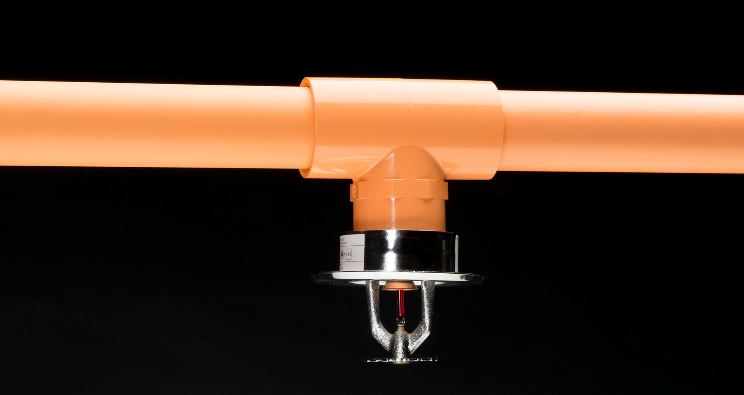
Are BlazeMaster® CPVC Fire Protection Systems as Reliable as Steel?
For years, building owners and contractors have relied on steel as the standard material for fire sprinkler systems. After all, steel is strong, durable, and stands up well to intense heat.
But steel is hard to work with─it takes a long time to weld, is often connected by threaded joints which can be messy to make onsite and is prone to corrosion and scaling over time. In addition, retrofitting a building with a steel fire protection system requires displacing occupants and can delay construction timelines.
Fortunately, you have options. Specialized engineering and processing systems have dramatically shifted the capabilities of different materials, specifically plastics. Introduced for fire protection systems in 1984, chlorinated polyvinyl chloride (CPVC) has redefined what can be expected of any fire sprinkler system.
But why trust CPVC over steel for your next new construction or retrofitting project? Our recent guide, compares the two materials across six key factors. Below, we’ve highlighted three of these factors.
CPVC Saves Money
In our CPVC vs. Steel 2018 Cost Savings Report, we cover how a BlazeMaster® Fire Protection System can save up to 30% in costs as compared to an all-steel solution, depending on the building structure and the amount used. Here’s how:
- CPVC installations are faster and easier to complete, which saves substantial time and resources.
- CPVC’s material costs are lower and more stable than steel’s.
- Compared to steel, CPVC allows for quicker and easier repairs and requires far less continual maintenance, which saves on material and technician costs.
- CPVC piping requires smaller pipe diameters than steel for the same hydraulic flow, which reduces overall material costs.
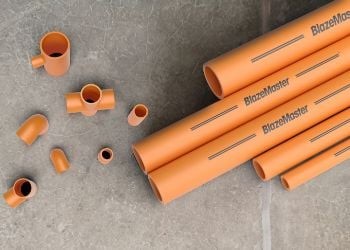
CPVC is Easier to Install
Steel piping is heavy, rigid, and requires special tools. To manoeuvre it around a job site, special equipment and two or more installers are needed. It’s often too rigid to manoeuvre through tight spaces and install in hard-to-reach areas, and installation requires torches and loud threading machines.
In summary, steel fire system installation means more installers, expensive machinery, costly hot-work permits, prefabrication, and vacating occupants from the premises.
CPVC piping, on the other hand, weighs less, is flexible and is joined together using a quick, one-step solvent cement process. Compared to steel, a CPVC fire sprinkler system results in:
- Cleaner, quieter installation.
- Only one installation contractor as opposed to multiple.
- On-the-spot fabrication, even in tight spaces.
- No necessary vacating of building tenants.
CPVC Resists Corrosion
Steel piping systems in any application, including fire sprinkler systems, are susceptible to corrosion. Corrosion degrades the interior of a pipe, which creates more friction along its surface and ultimately slows water flow.
In fact, VdS, a German fire safety firm, found that 73% of dry steel systems have significant corrosion issues at 12.5 years old and 35% of wet systems have significant corrosion issues after 25 years. However, these damages can occur “as soon as two years after installation.”
Steel pipes are also susceptible to scaling, which occurs when dissolved minerals drop out of the water and attach to the pipe wall, often near fittings and corners. As this scaling builds up, it can limit or entirely block water flow.
CPVC resists corrosion and scaling for up to 50 years of service life. When it comes to a long-lasting and reliable fire sprinkler system, CPVC piping is a stronger choice than steel.
Fire Protection System Standards, Codes, and Approvals Met By BlazeMaster® CPVC
CPVC broke into the plumbing and industrial piping industry in the late 1950’s, but it took a couple of decades to reach the highly regulated fire protection segment.
Organizations invest significant time and money to save lives and protect their property, so it makes sense that there are intense regulations, stipulations, and requirements on the capabilities of materials that can be used in fire protection systems.
It is the continuously growing list of certifications and approvals that has played a huge role in the success of BlazeMaster® CPVC.
BlazeMaster CPVC Listings and Approvals
BlazeMaster CPVC has become the most specified nonmetallic fire sprinkler piping system in the world. It stands out from other CPVC because it’s specially engineered for fire protection applications, which has allowed it to satisfy standards and earn listings and approvals from multiple major international agencies.
National Fire Protection Association (NFPA)
The NFPA is the world’s leading advocate of fire protection and authoritative source on public safety. Working closely with the community to understand their needs and risks, they set standards for manufacturers to abide by, thus reducing the burden of fire and other hazards on the quality of life.
BlazeMaster CPVC satisfies multiple standards set by the NFPA, including:
- NFPA 13: An industry benchmark standard for the installation of sprinkler systems. As a long-time member of the NFPA, BlazeMaster CPVC meets the NFPA 13 standard and is approved for all light hazard applications.
- NFPA 13D: A subsection of NFPA 13, NFPA 13D applies specifically to standards for the installation of fire sprinkler systems in one- or two-family dwellings as well as mobile and manufactured homes.
- NFPA 13R: Another NFPA 13 related standard, NFPA 13R sets standards for fire sprinkler systems in residential properties up to four stories, including multifamily units, hotels and student housing.
Underwriter Laboratories (UL)
UL is a global independent safety science company dedicated to promoting safe living and working environments.
The rigorous UL 1821 fire test was one of the first listings BlazeMaster CPVC earned back in the 1980’s. It requires that the material sits at a minimal distance from a 1,600°F (871°C) flame, with the fire plume touching the pipe at 700-900°F (371-482°C).
The pipe and fittings can survive these temperatures until the sprinkler head activates after 1-3 minutes, depending on the testing configuration.
BlazeMaster is UL Listed, C-UL and ULC for the following:
- UL 1821 – Thermoplastic Sprinkler Pipe and Fittings for Fire Protection Service
- UL 1887 – Standard for Safety Fire Test of Plastic Sprinkler Pipe for Visible Flame and Smoke Characteristics
- ULC/ORD – C199 – Combustible Piping for Sprinkler Systems
The American Society for Testing Materials (ASTM)
ASTM International is an international standards organization that develops and publishes technical standards for a wide range of materials, products, systems, and services. These standards include pipe dimensions and pressure bearing capabilities―all of which are met by BlazeMaster CPVC.
- BlazeMaster pipe is manufactured in SDR 13.5 dimensions to the requirements of ASTM F422
- BlazeMaster fittings 3/4 in. (19mm) through 1-¼ in. (32mm) are manufactured in Schedule 40 dimensions
- BlazeMaster fittings 1-1/2 in. (38mm) through 3 in. (76mm) are manufactured in Schedule 80 dimensions
- BlazeMaster fittings are manufactured to the requirements of ASTM F437, F438, F439 or F1970.
Revision to ASTM F442:
- New markings are required on pipe production as of January 1, 2014.
- The revision to ASTM F442 was approved in April, 2013.
- The revised standard specifies two material classifications.
For CPVC ASTM 4120-05 requires piping to meet the following pressure ratings at the given temperature:
- 320 psi @ 73°F (22.8°C)
- 80 psi @ 180°F (82.2°C)
BlazeMaster is the first CPVC Manufacturer to meet ASTM 4120-06 for CPVC, which increases the pressure rating at 180°F (82.2°C):
- 320 psi @ 73°F (22.8°C)
- 100 psi @180°F (82.2°C)
NSF International (NSF)
NSF International is an independent, not-for-profit organization that provides protection by certifying product suitability for food, water, air, and consumer goods. BlazeMaster CPVC is certified for potable water conveyance per NSF/ANSI 14 Plastics Piping System Components and Related Materials and NSF/ANSI 61 Drinking Water System Components – Health Effects.
Water Regulations Advisory Scheme (WRAS)
Similar to the NSF, BlazeMaster CPVC is approved by WRAS, the authority for water regulations in the United Kingdom, ensuring that materials and systems for water transport are both sanitary and efficient.
FM Global
FM Global is a third-party organization that approves materials for specific uses. Through FM Global, our BlazeMaster pipe and fittings are approved as manufactured by our partner manufacturers for use in exposed above ground wet pipe fire protection systems for light hazard occupancy sprinkler systems. Read more about the partner manufacturers here.
Loss Prevention Certification Board (LPCB)
Similar to UL, LPCB offers listings and certifications on materials for use in fire protection in the United Kingdom.
BlazeMaster’s listings with the LPCB speak to its global recognition―traditionally, steel fire sprinkler systems were the global choice for retrofits and residential installations, but now CPVC has become the material of choice.
BlazeMaster is the Most Specified CPVC Sprinkler System in the World
There’s no trait more important in the fire protection industry than reliability. BlazeMaster CPVC’s growing collection of listings and approvals are a testament that no other piping material is more reliable.
In addition to the worldwide approval, BlazeMaster Fire Protection Systems are supported by our Quality Assurance Program by which our partner manufacturers must exhibit a proven track record of consistent quality and reliability.
6 Common Misconceptions About BlazeMaster® CPVC Fire Sprinkler Systems
While steel fire protection systems have been the traditional choice for retrofits and residential applications, CPVC, or chlorinated polyvinyl chloride, has a proven track record of cost-effective and time-saving installations. With 600 million meters (1,968 feet) of piping system installed in more than 60 countries, BlazeMaster® CPVC Fire Protection Systems has become a safe, secure and reliable alternative material to steel in fire sprinkler systems.
Still, some installers and specifiers have reservations about CPVC’s suitability for fire protection systems. Below, we dispel some of the common myths we hear from contractors and building owners.
Myth 1: “CPVC will surely melt in a fire.”
Fact: CPVC piping has achieved the best possible fire-protection classification of a non-metal material, which is Bs1d0:
- Fire behavior: B = low flammability with no contribution to flashover.
- Smoke development: s1 = low smoke development.
- Flaming droplets: d0 = no burning drops.
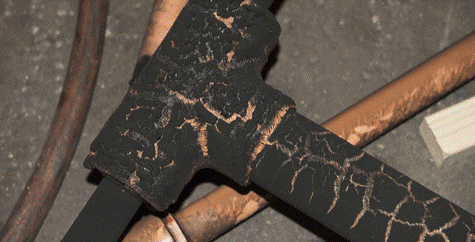
During a UL test, as shown in the picture above, a fire plume between 370°C (698℉) and 483°C (901.4℉) came in direct contact with BlazeMaster CPVC piping for 10 minutes.
This example shows that when exposed to a fire, CPVC piping forms a charring layer on the pipe’s exterior, which then functions as a thermal barrier to reduce heat conduction. Water flowing through the pipe also cools the inside, further reducing the burning rate.
Myth 2: “CPVC is too expensive.”
Fact: With an easy one-step solvent cement joining system, BlazeMaster Fire Protection Systems require:
- Reduced installation time, saving labor costs.
- No additional tooling, saving money on hire and maintenance.
- Lower life-cycle costs, saving on long-term maintenance.
A recent study found that using BlazeMaster Fire Protection Systems for a retrofit in a 40-bed care home would take fewer than half the installation hours (only 640 vs. 1,320), generating a significant saving in project cost.
Myth 3: “It won’t perform as well as steel.”
Fact: BlazeMaster CPVC piping systems offer superior hydraulics compared to steel, that:
- Achieve C-factor of 150 for hydraulic capabilities, unlike steel which has a starting C-factor of 120 and decreases over time.
- Do not corrode over time like steel.
As steel piping corrodes, water flow levels decline. Conversely, CPVC keeps the piping system ready for an emergency by preventing scaling and corrosion for more than 50 years. A BlazeMaster CPVC fire protection system also provides natural immunity to microbiologically influenced corrosion (MIC).
Myth 4: “CPVC is bad for the environment.”
Fact: BlazeMaster Fire Protection Systems outperform steel in 12 out of 13 environmental categories, including:
- Climate change impact.
- Metal depletion.
- Energy consumption.
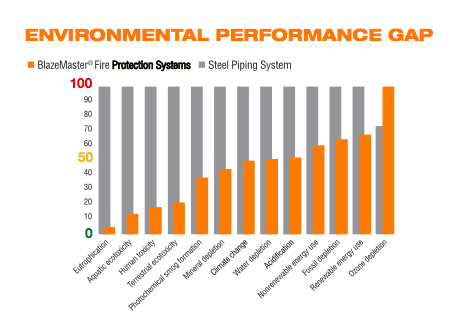
This means that BlazeMaster Fire Protection Systems have half the climate change impact compared to steel.
BlazeMaster Fire Protection Systems emerged as a much stronger choice for an environmentally friendly fire sprinkler solution.” – Michael Collins, Technical Director Environmental Resources Management
Myth 5: “It’s not approved by industry bodies.”
Fact: BlazeMaster Fire Protection Systems have long been an approved solution in the United States and United Kingdom for all of your retrofitting and residential fire sprinkler requirements. As well as being listed by UL, FM Global and LPCB, they also meet:
- NFPA 13 – light hazard occupancies: The design and installation of automatic fire protection systems benchmark.
- BS9251: The main British Standard covering UK fire sprinklers.
- BS EN 12845: The classification of hazards and provision of water supplies.
- ASTM 4120-06: The international standards for testing and materials. BlazeMaster is the first and only CPVC manufacturer to meet ASTM 4120-06.
- NSF/ANSI 14 and NSF/ANSI 16: International certification for potable water conveyance for Plastics Piping System Components and Related Materials & Drinking Water System Components – Health Effects.
BlazeMaster Fire Protection Systems have also been approved for use across single-family residences, multi-family occupancies and retrofit projects, proving that they are viable solution for installers and specifiers.
Myth 6: “It’s hard to install.”
Fact: BlazeMaster Fire Protection Systems are actually easy and quick to install for many reasons. Installation can be completed with a simple one-step joining system, which eliminates the need for torches or heat-fusion techniques, electricity and prefabrication.
Not only does CPVC piping offer an easier installation, it also:
- Offers a cleaner and quieter installation.
- Does not require the building to be abandoned.
- Minimizes disturbance to tenants during retrofit installations.
- Reduces installation time, and therefore, costs, compared to steel.
- Is lightweight, meaning installations in hard-to-reach areas are much easier and special equipment is not required to move it around a project.
BlazeMaster CPVC Provides the Reliability You Need
Engineered for fire protection through groundbreaking R&D at Lubrizol, BlazeMaster technology continues to set the industry standard.
As an installer, specifier or builder, do you hold any misconceptions about CPVC? Our team of piping systems consultants are available to speak with you about BlazeMaster CPVC, or your next fire protection requirements.
It’s also worth noting that not all orange pipe is the same. If you’re looking for reliability for life, choose BlazeMaster Fire Protection Systems.
Busting 5 Misconceptions About BlazeMaster® CPVC Fire Protection Systems
It’s a fact: BlazeMaster® CPVC is the world’s most specified non-metallic fire sprinkler system pipe and fitting material. Every day since it was introduced in 1984, BlazeMaster CPVC has saved the lives of countless individuals, firefighters and other safety professionals and prevented property damage.
How? By simply doing the job it was intended to do – suppressing a fire before it is able to spread.
That’s why it’s puzzling that even after more than 30 years, misconceptions about CPVC fire sprinkler systems still resonate.
I’d like to put five of those myths to rest, once and for all.
Myth #1: All Orange Fire Protection CPVC Pipe and Fittings are the Same
Far from it. BlazeMaster CPVC’s unique formulation allows it to outperform all other brands of CPVC fire protection pipe and fittings when the heat is on, ensuring that the fire sprinkler system suppresses a fire and protects occupants and property.
Differences in manufacturing, material science and chemical processing among CPVC brands directly translate to performance and reliability disparities. BlazeMaster CPVC not only meets standards, codes and approvals, but in some cases actually exceeds the requirements. Such is the case with burst and impact resistance testing.
Our manufacturing partners have proven track records of producing the highest quality materials and must comply with our Quality Assurance Program to ensure that each component is manufactured with consistent quality.
This is important because the quality of the CPVC piping in a fire sprinkler system can make all the difference in the event of an emergency.
In short, not all CPVC is the same. It is important to always choose “the right orange.”
Myth #2: The FBCTM System Compatible Program Covers ALL Brands of CPVC Fire Sprinkler Pipe and Fittings
Need another reason to “choose the right orange?” Lubrizol Advanced Materials’ FBC™ System Compatible Program is the oldest and most trusted chemical compatibility program in the industry.
However, for fire protection, this program covers BlazeMaster CPVC pipe and fittings only. It does not apply to any other brand of CPVC fire sprinkler pipe and fittings.
Why? Different resin formulations among CPVC manufacturers mean that ancillary construction products may perform differently when these products come in contact with CPVC pipe and fittings.
Each listed product is voluntarily submitted by its manufacturer for formulation screening and testing at a third-party laboratory. Once a product receives a certification by the FBC™ System Compatible Program, it means it has undergone rigorous compatibility testing with Lubrizol CPVC products only.
So why is all of this important? Ensuring that CPVC pipe and fittings are compatible with ancillary construction and/or maintenance products can make all the difference between system reliability and failure. At the very least, failures will be costly to the building owner, installer, manufacturer or a combination thereof. Examples of this include failures at a newly-renovated 19-story Dallas hotel and a 10-story multifamily complex in Louisiana, both outfitted by a competitor brand of BlazeMaster CPVC.
Myth #3: The Total Installed Cost of BlazeMaster CPVC Systems is More Than That of Steel Systems
BlazeMaster CPVC outperforms steel in material, labor and life cycle/maintenance costs.
Material costs can make up more than 60% of the total cost of a fire sprinkler system. BlazeMaster CPVC pipe and fittings are less expensive than steel, and smaller diameter pipe can typically be used to achieve the same flow rates.
BlazeMaster CPVC installs faster and easier than steel pipe systems. BlazeMaster CPVC is installed with a quick, simple one-step joining method that does not require torches or heat-fusion installation. It requires no pre-fabrication, saving labor and reducing the need for expensive joining equipment like with steel. We’re always there for the installer/contractor with best-in-class online training, or in-person training in conjunction with one of our manufacturing partners.
For the building owner, BlazeMaster CPVC offers lower life cycle costs as well as peace of mind. With BlazeMaster CPVC, you’ll never have to worry about the issues you can face with steel pipe systems, such as corrosion or scaling that not only affect hydraulics, or pinholing that can cause system leaks and failure. A BlazeMaster CPVC fire protection system also provides natural immunity to microbiologically influenced corrosion (MIC).
Myth #4: BlazeMaster CPVC Can Only be Used in Residential Applications
While BlazeMaster CPVC is most commonly used in single and multifamily homes, it has been used in commercial buildings for more than 30 years. BlazeMaster CPVC can be used in any light hazard occupancies as defined by NFPA 13, such as office buildings, schools, care homes, hospitals, theaters and places of worship.
Its reliable performance in these settings helps increase occupant safety while minimizing a fire’s potential to spread.
Want proof? Read how BlazeMaster CPVC was chosen to:
- Protect a housing and business complex in Atlanta, Georgia
- Bring Broward County, Florida school buildings up to code.
Want to know more? We’d love to share our success stories with you – just ask!
Myth #5: BlazeMaster CPVC Is Not Environmentally Friendly
A 2011 ISO-compliant peer-reviewed life cycle assessment (LCA) determined that BlazeMaster CPVC has approximately half the climate impact of steel. In fact, BlazeMaster CPVC outperformed steel in 12 of the 13 environmental categories tested, including climate change impact, energy consumption and water depletion.
What is more, even though CPVC is recyclable, the study assumed no CPVC recycling while assuming a 100% recycling rate for steel.
If you are a specifier, architect, installer, AHJ or building owner and would like to know more about the benefits of CPVC, we’re at your service! Schedule a free consultation with our team of BlazeMaster CPVC consultants today.